Converse International School of Languages
Courses
Our integrated CISL curriculum combines speaking skills, pronunciation, grammar, vocabulary building, reading, writing, and listening. Small classes (...
English Courses Overview in San Diego, California
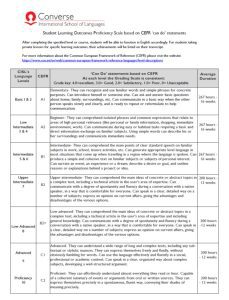
Our integrated CISL curriculum combines speaking skills, pronunciation, grammar, vocabulary building, reading, writing, and listening. Small classes ( average 7 students ) per Adult, average 14 students per Junior classes, and maximum 4 students per Premier classes guarantee that you will receive a high level of personal attention and maximum learning opportunities. Our Interactive Teaching Method engages you in the learning process so that you learn communication skills and develop confidence quickly. We offer 10 possible levels, so there will be a class which is just right for you. Our custom-made online placement test will determine your correct level. Throughout the course, your progress will be evaluated according to the CISL Grading Standards. An exit test during your last week will measure your progress. You will receive a Converse International School of Languages English Certificate and a detailed report of your progress in each skill area. We base our achievement scale on the CEFR. For more information about the Common European Framework of Reference (CEFR) please visit the website: https://www.coe.int/en/web/common-european-framework-reference-languages/level-descriptions The minimum age for our Adult Courses is 18 years. The age range for our Junior courses is 10 – 17 years.
A Results-driven Teaching Style
CISL lessons are based on the premise that clear aims and hard work yield the best results. All lessons are taught in the CISL style, focusing on the following key features: - transparent objectives, clearly identified at the beginning of each lesson - focus on key language skills and language learning strategies - appropriate time limits set for each activity - a pace calculated to challenge the learner at all times - interaction between teacher – student (and student – student as appropriate), individual and group study exercises, which consolidate classroom activities and preparation time to maximize the benefits of the lesson - feedback on progress achieved at the end of lessons.
Student Learning Outcomes Proficiency Scale
Student Learning Outcomes Proficiency Scale
CISL Course Grading
4 : Student uses tenses, word order and other grammatical constructions correctly and confidently and with little prompting; when a mistake is made, he/she recognizes it and self-corrects. New material is adopted readily into conversational repertoire and little repetition is needed. 3: Although mistakes are made, particularly in verb inflections and negative/interrogative forms, student understands Grammar presented and uses it correctly at least 75% of the time. Attempts frequently to self-correct although some prompting is needed. When practiced sufficiently, new material is accepted into conversational repertoire with increasing confidence. 2: Student tends to fall back on previously learned, more basic, tenses and structures and has difficulty integrating new material into his/her conversation. Limited awareness of his/her own speech patterns and limited self-correction. Needs frequent prompting and repetition. Uses correct Grammar appropriately 50% of the time. 1: Student struggles to understand new structures and is reluctant to add new material to conversational repertoire, preferring to rely upon fa.m.iliar basic material. Often does not “hear” or internalize corrections and needs constant prompting. Tends to use one or two basic tenses with choppy, inappropriate sentence structure and word order. Conversational repertoire is relatively static. Shows little confidence and little or no attempt at self-correction; constant repetition is necessary. 4: Student speaks up confidently, using complete sentences and incorporating new material in his/her utterances. Is able to sustain conversations with classmates and teachers with minimal prompting. and with native speakers outside the class, provided the native speakers make allowances for student’s restricted vocabulary. Makes some errors but these do not impede communication. Is eager to speak. Can ask and answer questions with equal facility and makes a constant and successful effort to speak only English in the class. 3: Student makes errors, particularly in tense and in fra.m.ing questions, and is concerned about making errors, but confident enough to maintain an effective conversation with classmates and teachers. Is less confident with native speakers but is able to communicate, especially when conversation is on fa.m.iliar ground. Can ask for repetition and/or clarification if he/she gets confused, and if his/her listener does not understand, student can re-state effectively. Is mindful of English-Only rule and has only momentary lapses. 2: Student lacks confidence in speaking ability and is often held back by fear of making an error. Tends to use short and/or incomplete sentences if not prompted/reminded. Often falls back on present tense and has great difficulty asking questions correctly. Is not very comfortable using language outside of class and has great difficulty communicating with native speakers. Conversation contains many pauses for thought. Frequently uses native language in class to ask other students a question, despite teachers’ reminders. 1: Student is reluctant to speak, particularly longer utterances, such as descriptions or presentations. Falls back on sentence fragments and often omits inflections, particles, etc. Tends to use only one tense and question formation is difficult for him/her. Replies often limited to “Yes,” “No,” or “I don’t know.” Conversation includes many long pauses (and even attempts to look in a dictionary) and student may simply give up and/or refuse to speak. Communication with native speakers is extremely rudimentary. Lack of confidence may also make the student unwilling or unable to “speak up” so that others have difficulty hearing and understanding him/her. Constantly breaks English Only rule, not only to ask questions of other students, but also to make asides to them. 4: Student is prepared, involved and always active in class. He/she listens attentively to both the teachers and to fellow students as well, and is ready to join in activities and discussions to the best of his/her abilities. Often willing to initiate discussions or activities. He/she attends class regularly (more than 85% attendance), is punctual and follows school rules. Is supportive of other students’ efforts, follows instructions willingly and is an enthusiastic participant and learner. 3: Student is well prepared most of the time. Active in class but more likely to follow discussions than to initiate or lead them. Attendance is at least 85%, and although he/she may sometimes arrive late, he/she is generally punctual. He/she relates well to classmates and to teacher and participates willingly in class activities. Student may be momentarily distracted but generally is attentive and focused in class. 2: Student is often unprepared in class, leading to his/her unwillingness to participate actively in class; is sometimes unresponsive. Tends to relate to one or two friends rather than to class as a whole. Often these friends are of the sa.m.e nationality, leading to fairly frequent use of native language and distraction of several students. Sometimes resists participating in activities that “do not suit” him/her, regardless of what the rest of the class is doing. Often late. Attendance is below 85%. 1: Student is usually unprepared. Is unwilling to participate in class work, particularly oral exercises, and sometimes simply refuses to join in class activities. Is dismissive or combative concerning school rules. Is distracted and distracts other students with frequent asides and comments, and often interrupts at inappropriate moments, often in his/her native language, despite repeated admonitions to the contrary. Late more than 3 times a week, attendance is below 70%. 4: Student prepared presentation on time and well. Topic well planned and thought out. Student did not need to refer to notes or script during his/her presentation. Speech and content were clearly communicated to class and presented with confi
Latest Blog Posts for English Courses in California
CISL Cultural Workshops are an immersion into culture in the United States, and a unique opportunity to experience life at... Do you want to study English? Have you always dreamed of visiting the United States? If so, keep reading. According... Can you speak about a topic in English for 45 seconds? Then you’re ready for TOEFL. Or are you? TOEFL... 50 Some English expressions are just old and outdated . . . or they’ve lost their meaning from overuse. Avoid... Are you taking the CAE or FCE Exam soon? Many students feel like they can prepare for some parts of... Do you know how to prepare yourself for the IELTS Speaking Paper? Follow these tips and learn this vocabulary and... [category_one]